Table of Contents
- What Mobile Fleet Detailing for Small Business Actually Requires
- Step 1: Build a Fleet Vehicle Cleaning Checklist That Wins Contracts
- Step 2: Set a Fleet Detailing Schedule Around Client Operations
- Step 3: Price Your Services With a Fleet Detailing Cost Model
- Step 4: How to Choose a Fleet Detailing Provider (Or Become One)
- Prospecting, Sales, and Recurring Contracts for Fleet Detailing
- Step 1: Build a prospect list that maps to a decision-maker
- Step 2: Lead with downtime, not price
- Step 3: Turn the walkthrough into a one-page proposal
- Step 4: Follow up on a schedule, not on a feeling
- Step 5: Put the relationship in a service-level agreement
- Step 6: Plan capacity before you promise a schedule
- Step 7: Measure the value you are delivering
- Conclusion: Building a Fleet Detailing Business That Lasts
- Frequently Asked Questions
Last Updated: October 5, 2026
What Mobile Fleet Detailing for Small Business Actually Requires
Mobile fleet detailing for small business means cleaning vehicles at a company’s own lot, yard, or job site instead of sending trucks to a shop.
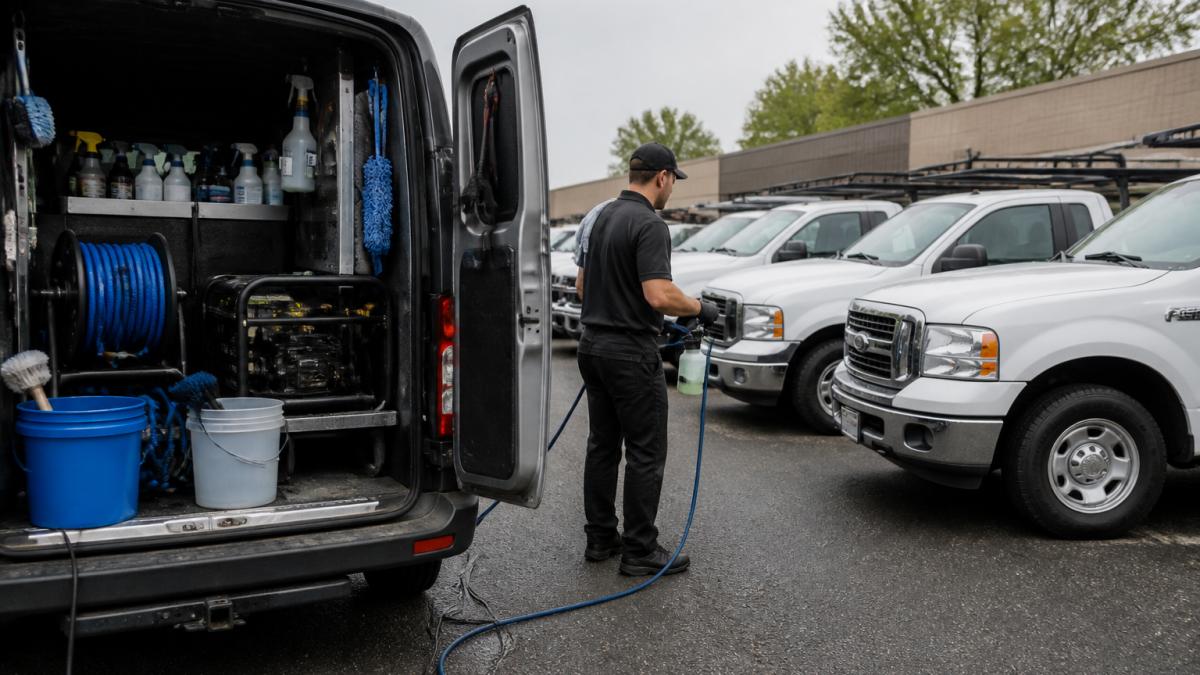
The appeal is simple: a plumber with six vans cannot afford to lose two vans a day to a shop across town. On-site service solves it, the work happens in the client’s own space, on the client’s own schedule.
Mobile Setup: Water, Power, and Equipment You Need On Site
A mobile detailing setup needs three things at every job: water, power, and the right tools. Most mobile units carry their own water tank and generator, so they never depend on the client’s utilities, a fleet yard may have no outdoor spigot, and a job site may have no power.
The core equipment list looks like this:
- Water tank (100-200 gallons) and a low-pressure pump
- Quiet generator for power
- Pressure washer with adjustable nozzles
- Wet/dry vacuum and steam cleaner
- Microfiber towels, brushes, and interior tools
- Wash mitts, buckets, and a grit guard
- Polisher for paint correction work
- Ceramic coating supplies for protection jobs
- Wastewater containment mat or reclamation system
That last item matters more than most new operators expect: runoff contains dirt, soap, and road grime, and many areas restrict where it can go. Check local stormwater rules first.
Startup Costs and Business Permits to Budget For
Startup costs fall into three buckets: equipment, vehicle, and licensing. A basic van or trailer setup is the biggest single expense, followed by equipment, tanks, and a generator, then permits, insurance, and registration.
Common permits and requirements include:
- A business license in your city or county
- A seller’s permit if your state charges sales tax on detailing
- Commercial auto insurance for your work vehicle
Fleet clients usually ask for proof of insurance before signing. Get that paperwork ready early.
Step 1: Build a Fleet Vehicle Cleaning Checklist That Wins Contracts
A written fleet vehicle cleaning checklist is your best sales tool. It shows a fleet manager exactly what they get, every time, for every vehicle, the consistency that turns a one-time wash into a recurring contract.
Exterior checklist:
- Pre-rinse to lift loose dirt
- Wheel and tire cleaning
- Two-bucket hand wash
Interior checklist:
- Vacuum seats, carpets, and trunk
- Wipe dash, console, and door panels
- Clean cup holders and vents
Hand this checklist to a fleet manager and you are no longer quoting a wash, you are quoting a documented service.
Add a photo column to your checklist. A quick before-and-after photo per vehicle settles most billing disputes and gives the fleet manager proof for their own records.
Step 2: Set a Fleet Detailing Schedule Around Client Operations
A fleet detailing schedule should match how the client actually uses their vehicles.
A rough rule: exterior maintenance cleaning every two to four weeks, full interior and exterior detailing every two to three months.
Then plan capacity: if one detailer can finish four to six vehicles in a shift, a twelve-truck fleet needs two or three visits, not one.
Step 3: Price Your Services With a Fleet Detailing Cost Model
Fleet detailing cost should be built from labor time, supplies, travel, and overhead, not guessed. A per-vehicle price that ignores drive time will lose money on a fleet spread across three locations.
The three pricing models, and when each one wins
There is no single correct way to price fleet work. The right model depends on how predictable the client’s fleet is.
| Model | How it works | Best when | Risk to you |
|---|---|---|---|
| Per vehicle | Flat rate per unit, by size and service level | Fleet size and mix are stable | Underestimating condition or size |
| Hourly | Billed at your shop rate for time on site | Condition varies wildly, or scope is unclear | Client watches the clock and pushes back |
| Monthly retainer | Fixed fee for a set number of visits and vehicles | Recurring maintenance contracts | Scope creep if the agreement is vague |
For small fleets, roughly five to twenty-five vehicles, a per-vehicle rate inside a monthly retainer is most common: the client gets a predictable line item, you get a predictable route.
Build your floor rate first
Before you quote anyone, calculate the lowest per-vehicle price you can charge and still make money:
- Labor hours per vehicle. A maintenance wash on a cargo van is faster than a full detail on a crew-cab pickup. Time a few of each before you guess.
- Supply cost per vehicle. Soap, dressings, microfiber, and consumables add up. Track one month of receipts and divide by vehicles serviced.
- Travel time. Round-trip drive time divided across the vehicles you clean in that visit. A two-hour round trip on a four-vehicle job adds thirty minutes to every vehicle.
- Overhead. Insurance, vehicle payment, fuel, phone, software, and admin time. Divide monthly overhead by billable vehicles.
- Target profit margin. Pick a margin and hold it. Discounting below your floor means you bought a job, not a client.
Add those five numbers and you have your floor; anything below it is a loss you have chosen to take.
A worked example (assumptions, not a quote)
Here is how the math looks with round numbers, illustrative assumptions only.
- Labor: 1.5 hours per vehicle at a $45/hour internal cost = $67.50
- Supplies: $8 per vehicle
- Travel: 1 hour round trip across 6 vehicles = 10 minutes per vehicle, or about $7.50 at the same internal rate
Run the same math on a full detail that takes 3.5 hours: the floor roughly doubles, and the quote should too. If your maintenance-wash and full-detail prices are within a few dollars, your model is broken.
Per-vehicle vs. hourly vs. monthly, side by side
Take a 12-vehicle fleet needing a maintenance wash every two weeks.
- Per vehicle: 12 vehicles × $158 = $1,896 per visit, $3,792 per month
- Hourly: 12 vehicles × 1.5 hours = 18 hours at a $95/hour billed rate = $1,710 per visit
- Monthly retainer: Two visits per month at a negotiated $3,500 flat, which gives the client a small discount for commitment and gives you guaranteed revenue
The retainer usually wins once the fleet is stable: the client gets budget certainty, and you get a plannable route.
What actually moves the price
- Vehicle size and type. A compact van is not a lifted pickup. Price by class, not by “truck.”
- Condition at first service. A fleet never detailed costs more to bring up to standard. Consider a one-time deep clean, then the recurring rate.
- Frequency. More frequent visits mean less per-visit labor, which you can pass through as a modest discount.
Quote a range on the first walkthrough, then confirm a firm number after the first visit. First-visit condition is the single biggest variable, and locking a price before you see the worst vehicle in the fleet is how operators lose money on month one.
Put the price in writing
Every quote should state the per-vehicle rate, service level, frequency, number of locations, and what triggers a re-quote (fleet size change, condition change, added services like paint correction or ceramic coating). Pricing depends on vehicle count, condition, and location, so we quote each fleet after a short site review. For current rates, check our service page or request a quote.
Step 4: How to Choose a Fleet Detailing Provider (Or Become One)
Choosing a fleet detailing provider comes down to five checks: insurance, equipment, references, scheduling flexibility, and a written service agreement.
Run this checklist before you sign:
- Proof of general liability and commercial auto insurance
- Own water and power supply, no reliance on your utilities
- References from at least two other fleet clients
If you are building your own business instead, the same list becomes your sales pitch. Every box you can check is a reason a fleet manager picks you over a cheaper quote.
Never start work on a fleet contract without a signed service agreement. Without one, a disputed scratch or a missed visit becomes your word against theirs, and you have no cap on the damage you may be asked to cover.
Prospecting, Sales, and Recurring Contracts for Fleet Detailing
Recurring contracts are where a mobile fleet detailing business becomes stable: one-time washes pay this week’s bills, monthly contracts pay next year’s. Most other providers chase retail customers and ignore fleets, the gap is not just who to call, but how to move a prospect from cold call to signed service-level agreement.
Step 1: Build a prospect list that maps to a decision-maker
Start with businesses that own or lease vehicles and feel the cost of downtime, then identify who controls the fleet budget.
- Contractors, plumbers, electricians, and HVAC companies, owner or operations manager
- Landscaping and tree service companies, owner or fleet supervisor
- Delivery and courier fleets, dispatch manager or fleet manager
In a small business the decision-maker is often the owner; in a mid-size fleet it is usually a fleet manager, operations manager, or shop foreman. Calling the front desk to ask “who handles your vehicle maintenance and cleaning?” beats guessing.
Step 2: Lead with downtime, not price
“We’re cheaper than the shop down the street” invites a price war you may not win. “We clean your trucks on your lot while your crews work” sells the outcome the fleet manager is measured on: vehicles on the road, not in line at a detail shop.
A short, specific opener works better than a long pitch:
“I noticed your vans are on the road early. We do on-site fleet cleaning in your yard, your drivers hand us the keys at the end of the day and get them back clean the next morning. Can I walk your lot for ten minutes and put together a one-page plan?”
That ask is small, specific, and easy to say yes to.
Step 3: Turn the walkthrough into a one-page proposal
Bring your checklists to the walkthrough. Count the vehicles, note sizes and conditions, and ask three questions: how many vehicles are typically on site at once, what is the busiest day for crews, and who signs off on vehicle maintenance spending?
Then send a one-page proposal within 24 hours. It should include:
- Fleet size and vehicle classes
- Service level (maintenance wash, full detail, or both)
- Recommended frequency and service window
One page beats a ten-page deck. Fleet managers do not have time to read a deck.
Step 4: Follow up on a schedule, not on a feeling
Most fleet contracts are not won on the first call, three to five touches is common. Put follow-ups on your calendar:
- Day 1: Send the proposal
- Day 3: Short call or email, “Any questions on the plan?”
- Day 7: Offer a single paid trial visit on two vehicles
A paid trial visit is your strongest closer: the fleet manager sees your checklist, punctuality, and before-and-after photos without committing to a contract.
Step 5: Put the relationship in a service-level agreement
A service-level agreement (SLA) turns a good first visit into recurring revenue, protecting both sides and removing the ambiguity behind most disputes. A practical SLA covers:
- Scope. Which vehicles, which service level, interior, exterior, or both
- Frequency. How many visits per month and on which days
- Service window. When your crew is on site and when keys are due
Step 6: Plan capacity before you promise a schedule
Signing a contract you cannot service is worse than not signing it. Before committing to a frequency, work out how many vehicles one detailer can finish in a shift, then add travel and setup time.
A simple capacity formula:
- Vehicles per detailer per shift × number of detailers = vehicles per visit
- Vehicles in fleet ÷ vehicles per visit = visits needed per cycle
If one detailer can finish four to six vehicles in a shift and the fleet has twelve trucks, that is two to three visits per cycle.
Step 7: Measure the value you are delivering
Fleet managers renew when they can see the return. Track and report a few numbers each month:
- Vehicles serviced vs. vehicles scheduled
- Average cost per vehicle
- Downtime hours avoided (vehicles cleaned on site instead of sent out)
A one-page monthly summary with those numbers renews contracts better than any discount and gives you data to raise your rate when costs go up.
The businesses that last in fleet detailing are not the ones with the lowest prices. They are the ones with written checklists, dependable schedules, and service-level agreements that make the client’s life easier, and a follow-up system that turns one signed contract into the next referral.
Conclusion: Building a Fleet Detailing Business That Lasts
The hard part of mobile fleet detailing is not the cleaning, it is the scheduling, pricing, and contracts that keep vehicles coming back month after month.
At Blue Ridge – Mobile Detailing, we handle fleet detailing and maintenance for commercial clients across the region. We also offer paint correction and ceramic coating to protect fleet finishes long term.
Ready to stop losing trucks to the shop? Schedule online with Blue Ridge – Mobile Detailing and keep your fleet clean, protected, and on the road.
Frequently Asked Questions
How often should a small business fleet be detailed?
Most small business fleets need a full detail every four to eight weeks, depending on vehicle use and local conditions. Work trucks exposed to road salt, construction dust, or daily highway driving may need exterior cleaning every two weeks with a deeper interior detail monthly. A fleet detailing schedule built around your operations keeps vehicles presentable without pulling them off the road for long stretches.
What services are included in fleet detailing?
A standard fleet detailing package covers exterior wash and wax, wheel and tire cleaning, interior vacuuming, dashboard and surface wipe-down, window cleaning, and odor treatment. For commercial vehicles, the goal is consistent professional appearance and vehicle protection across the whole fleet, not just a one-time deep clean.
How can I keep fleet detailing costs under control?
Fleet detailing cost depends on vehicle count, service frequency, and the level of cleaning required. To control costs, bundle multiple vehicles into a single on-site visit, commit to a recurring service agreement, and prioritize maintenance cleaning over full restoration for vehicles in good condition. Ask your provider for a per-vehicle rate at different frequency tiers so you can compare the total monthly spend rather than one-off pricing.
How do I find a mobile detailer for my business fleet?
Look for a provider with commercial fleet experience, not just residential car detailing. Ask whether they carry their own water and power supply, how they handle wastewater, and whether they can service multiple vehicles at your business location in one visit. Request references from other small business clients, confirm insurance coverage, and get a written service-level agreement that spells out scheduling, scope, and what happens if a vehicle is missed.