Table of Contents
- Mobile Boat Detailing for Salt Protection: What It Is and Why It Matters
- How to Remove Salt from a Boat: Step-by-Step by Surface
- How Often to Wash a Saltwater Boat: A Practical Maintenance Schedule
- Choosing Protection by Surface and Use: Wax vs. Marine Ceramic Coating
- Boat Detailing Cost Per Foot: What Drives the Price
- DIY vs. Professional Mobile Boat Detailing for Salt Protection
- Frequently Asked Questions
Last Updated: October 13, 2026
Mobile Boat Detailing for Salt Protection: What It Is and Why It Matters
Salt is the silent enemy of every boat that touches saltwater. It dries into sharp crystals that work into gelcoat, hardware, and upholstery, eating away at the finish from the inside out. Mobile boat detailing for salt protection brings the wash, rinse, and protective coating process to your dock or driveway, so your boat never sits coated in salt between outings.
Salt residue pulls moisture against metal fittings, speeding corrosion, and dulls gelcoat faster than almost anything else. A repeatable rinse-and-protect routine stops most damage before it starts.
Salt Damage Warning Signs to Catch Early
The first sign of salt damage is usually a chalky, dull patch on gelcoat that will not come back with a simple wipe, oxidation, which salt speeds up.
Watch for these signals:
- White crust or streaks along the waterline and rub rail
- Pitting or green-white film on stainless and chrome
- Stiff, faded vinyl and stitching that feels rough
Catch these early and a wash plus a protective coating handles them. Let them sit a season and you need compounding, polishing, or gelcoat restoration.
The most common mistake is waiting until the end of the season to wash off salt. Salt crystals keep pulling moisture into metal and gelcoat the whole time they sit there. Rinse after every saltwater outing, not once a month.
How to Remove Salt from a Boat: Step-by-Step by Surface
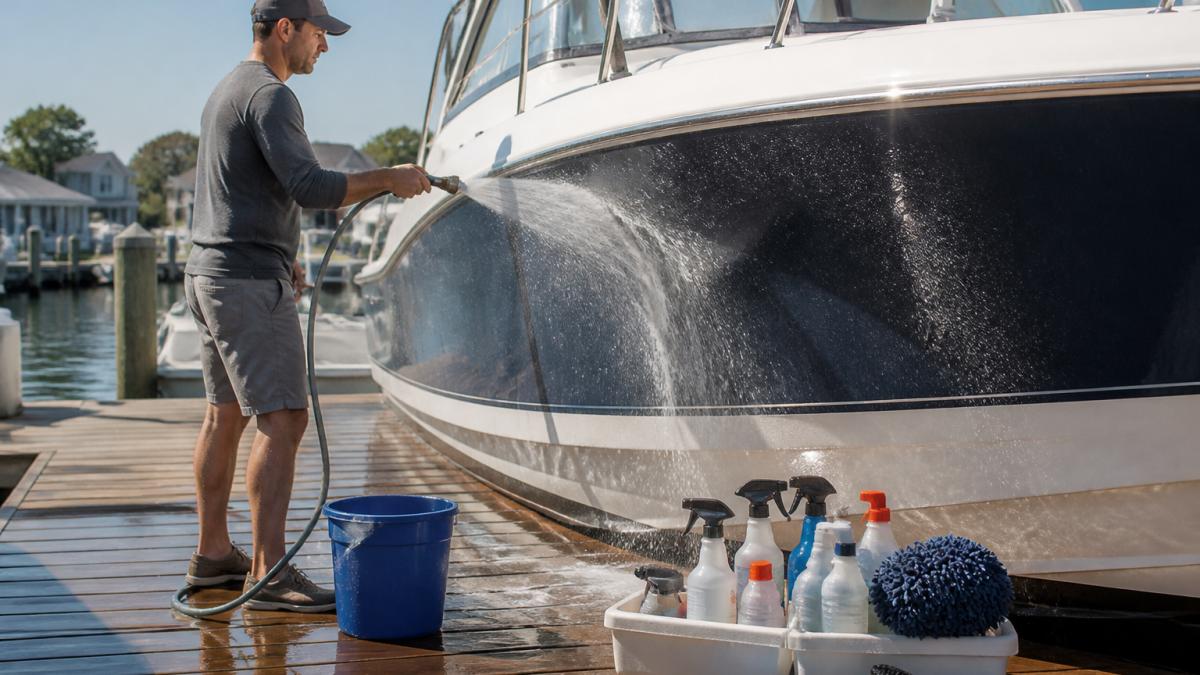
Freshwater rinsing is the core of salt removal, and the order matters: rinse top to bottom, wash, rinse again, dry, then protect. Skipping the pre-rinse drags salt crystals across the finish and scratches it.
The universal order (do not skip steps)
- Pre-rinse with fresh water, top to bottom. Start at the flybridge or hardtop and work down. This lifts loose salt before anything touches the surface. Use a gentle fan spray, not a pressure jet, on gelcoat and vinyl.
- Wash with a boat-safe detergent. Mix to the label’s dilution, most marine soaps run roughly 1 oz per gallon of water. Never use dish soap; it strips wax and leaves gelcoat unprotected.
- Scrub by section. Soft brush or wash mitt, one panel at a time. Do not let suds dry on gelcoat, dried soap leaves a film that traps salt.
- Rinse again, paying attention to seams. Salt hides under rub rails, around cleats and fasteners, in scuppers, and behind trim. A second pass flushes it out.
- Dry with a microfiber towel or chamois. Standing water leaves mineral rings and water spots, especially on dark gelcoat and glass.
- Apply protection last. Wax or ceramic coating goes on a clean, dry surface. Coating over residual salt locks it in.
Work in shade or early morning when possible. Direct sun dries suds and rinse water too fast, which is when spots and streaks form.
Gelcoat and hull
Gelcoat is the boat’s outer shield, and salt is its biggest threat. Wash the hull with a soft brush and boat-safe detergent in small sections so suds do not dry, paying extra attention to the waterline and transom, which collect engine and prop wash spray.
Once the hull is clean and dry, wax or ceramic coating keeps salt and pollutants from bonding to gelcoat, making the next wash faster and preventing fading. For visible oxidation, compound and polish before coating.
Stainless, chrome, and aluminum
Metal is where salt does its most expensive damage. Rinse and dry stainless and chrome, then apply a metal protectant to slow pitting. Never use the hull brush on metal, embedded grit scratches polished surfaces, so keep a separate soft cloth or metal mitt on board.
- Stainless steel: Rinse, dry, then wipe with a marine metal polish or protectant. Watch cleats, rails, and fasteners, which pit first.
- Aluminum: Use a cleaner labeled safe for aluminum. Harsh alkaline cleaners can discolor it.
- Chrome: Rinse and dry thoroughly; standing water leaves spots that etch over time.
Glass and clear vinyl
Clean glass with a marine glass cleaner to cut salt film and water spots. For clear vinyl (isinglass), use a plastic-safe cleaner and microfiber towel, ammonia-based cleaners cloud it over time. Rinse surrounding gelcoat first so you are not pushing salt onto the glass.
Vinyl, upholstery, and carpet
Interior surfaces take a beating from salt air, not just spray. Use a marine conditioner on vinyl, not a household product, because marine vinyl needs UV protection built in.
- Vinyl and cushions: Wipe with a mild marine cleaner, then apply conditioner. Rinse the cleaner off before conditioning so residue does not attract dirt.
- Carpet: Use hot-water extraction to pull salt and mildew out of the fibers. Salt left in carpet wicks moisture and feeds mildew.
- Canvas and covers: Rinse and air-dry fully before stowing. Folding a damp cover traps salt against the surface it is meant to protect.
Rinse technique and water use
On a freshwater lake you still need to rinse, contaminants, algae, and grime build up the same way, just without the salt load.
At a dock with limited water, a few habits stretch what you have:
- Rinse from a bucket with a microfiber mitt for the hull, then use the hose only for the final flush.
- Use a rinse-less wash for light salt film when water is restricted; follow the product’s dilution and use fresh microfiber towels per panel.
- Capture runoff where required by local rules, and avoid letting wash water run directly into the waterway. Many marinas post their own guidance, check with the dockmaster before washing in a slip.
Test spots and product safety
Before using any new cleaner, test it on a small hidden area, under a rub rail, inside a locker, or on a cushion underside. Marine-safe means compatible with gelcoat, metals, vinyl, and the waterway. Avoid abrasives on vinyl and clear vinyl, and never mix cleaning chemicals; some combinations release fumes or damage surfaces.
How Often to Wash a Saltwater Boat: A Practical Maintenance Schedule
Wash after every saltwater outing. Salt starts working the moment it dries, so the rinse is the single most important step in the routine. What most owners need is a repeatable schedule, plus a way to tell routine upkeep from damage that needs restoration.
Use this schedule as a baseline:
| Frequency | Task | Why It Matters |
|---|---|---|
| After every outing | Freshwater rinse, top to bottom; dry metal and glass | Removes salt before it dries and starts pulling moisture into fittings |
| Weekly | Full wash with boat-safe detergent; vinyl wipe-down | Clears grime, salt residue, and pollutants before they bond |
| Monthly | Wax or coating top-up; vinyl conditioning; metal protectant | Keeps the protective layer intact so the next wash is easier |
| Seasonally | Compounding, polishing, gelcoat restoration as needed | Reverses oxidation and fading that washing alone cannot fix |
| Annually | Full marine ceramic coating evaluation | Confirms long-term protection still holds |
The after-every-outing routine (10-15 minutes)
This routine prevents most salt damage without a full wash:
- Rinse the hull, rails, and hardware with fresh water, top to bottom.
- Flush the engine per the manufacturer’s instructions if the boat was in saltwater.
- Wipe down stainless, chrome, and glass with a microfiber towel.
- Leave lockers and covers open to air-dry before closing up.
If you cannot rinse after every trip, a protective coating buys you time between washes, but it does not replace the rinse.
Weekly and monthly tasks
The weekly wash catches what the quick rinse misses: waterline grime, rub-rail buildup, and salt film on vinyl. The monthly pass restores protection, a wax or coating top-up, vinyl conditioner, and metal protectant.
If you keep your boat in a slip, run a quick freshwater rinse on the hardware and rails even when you skip the full wash. Those small metal parts corrode first and are the most expensive to replace.
Routine maintenance vs. damage that needs restoration
Not every problem is a wash-and-wax job. Use these signs to decide between maintenance and restoration:
- Routine (wash and protect): light salt film, fresh water spots that wipe off, dull but even gelcoat that brightens with wax.
- Restoration (compounding and polishing): chalky gelcoat that will not come back with a wipe, oxidation that rubs off on your hand, faded or stained surfaces that wax does not improve.
- Repair (before detailing): pitting on stainless, rust blooms around fasteners, cracked or stiff vinyl, mildew that has stained cushions. These need treatment before any coating goes on.
Boats in a slip vs. trailered boats
Boats kept in a slip or on a mooring need more frequent rinsing than trailered boats because they sit in salt air constantly. A trailered boat rinsed and covered after each trip can stretch the weekly wash; a slip-kept boat usually cannot. If your boat lives in the water, treat the after-every-outing rinse plus a weekly wash as the floor, not the ceiling.
When water is limited
Dockside water is not always available, and some marinas restrict washing in slips. Options that work:
- Rinse-less wash products for light salt film, used per label dilution with fresh microfiber towels per panel.
- Bucket rinsing for the hull, reserving the hose for a final flush of hardware and seams.
- Onboard freshwater tank for a quick post-trip rinse when the dock has no spigot.
Choosing Protection by Surface and Use: Wax vs. Marine Ceramic Coating
Wax and marine ceramic coating both protect, but for different owners. Wax is the traditional choice: easy to apply and refresh, with a warm shine.
Marine ceramic coating is the longer-term option: a harder, more chemical-resistant layer that repels water and salt, cleans easier, and outlasts wax.
| Feature | Wax | Marine Ceramic Coating |
|---|---|---|
| Durability | Weeks | Months to years |
| Salt and water repellency | Moderate | High |
| UV protection | Limited | Strong |
| Best for | Trailered boats, frequent washers | Slip-kept boats, low-maintenance owners |
| Application | DIY-friendly | Best done by a certified installer |
Pick wax if you enjoy hands-on upkeep and rinse often; pick ceramic coating for protection that survives salt air with less work between washes.
Boat Detailing Cost Per Foot: What Drives the Price
Boat detailing cost per foot depends on size, condition, and the service. A basic exterior wash costs less per foot than a full detail with oxidation removal and ceramic coating, because labor and materials differ completely.
The main cost drivers:
- Length: Longer boats mean more surface area and more time.
- Condition: Heavy oxidation, stains, and mildew add hours of work.
- Service level: Wash only, versus wash plus compounding, polishing, and coating.
Because every boat is different, we quote each job after seeing the vessel. BoatUS guidance on boat maintenance and cleaning is a useful starting point for understanding what regular care involves.
DIY vs. Professional Mobile Boat Detailing for Salt Protection
DIY salt protection works if you have the time and right products: a freshwater source, boat-safe detergent, brushes, microfiber towels, and a protectant. The routine is simple and keeps costs down.
Professional mobile detailing makes sense when the job goes beyond a wash.
Here is how to decide:
- DIY if your boat is small, trailered, and rinsed after every trip.
- Professional if you see oxidation, want ceramic coating, or keep the boat in saltwater.
- Mobile professional if you want show-quality results without hauling the boat to a shop.
At Blue Ridge – Mobile Detailing, we bring the full process to your driveway, dock, or hangar.
Frequently Asked Questions
What is the best way to clean salt water off a boat?
Rinse with fresh water as soon as possible, starting from the top and working down. Use a boat-safe detergent for the hull and gelcoat, then dry with a microfiber towel to prevent water spots. Pay extra attention to metal fittings, cleats, and railings where salt residue collects. For a deeper clean, follow with a wax or marine ceramic coating to add a protective layer. Mobile boat detailing services can handle this on-site at your dock, saving you the trip to a wash rack.
How often should you wash a boat after saltwater exposure?
Rinse the hull, deck, and hardware with fresh water after every saltwater trip. Do a full wash with boat-safe detergent at least every two to four weeks during active use. If the boat sits in a slip, weekly rinses are better because salt air and spray keep depositing residue. A practical maintenance schedule includes a fresh water rinse after each outing, a full wash every two to four weeks, and a wax or coating reapplication every three to six months depending on the product.
Can ceramic coating protect a boat from saltwater?
A marine ceramic coating creates a semi-permanent barrier that repels water and makes it harder for salt residue to bond to the gelcoat, metal, and glass. It also adds UV protection against sun damage and makes routine washing faster. The coating does not replace rinsing after saltwater exposure, but it reduces how much salt sticks and simplifies cleanup. Most marine ceramic coatings last one to three years depending on the product and how well you maintain them.
How much do boat detailers charge per foot for a full detail?
Boat detailing cost per foot depends on the size of the vessel, the level of service, and the condition of the surfaces. A basic wash and rinse costs less per foot than a full detail that includes oxidation removal, compounding, polishing, and a protective coating. Mobile service may carry a different rate than a shop because the detailer brings water, power, and equipment to your location. Request a quote based on your boat’s length and the services you need for an accurate figure.
Salt does not wait, and neither should your protection plan. Every day a boat sits coated in salt is a day gelcoat fades, metal pits, and vinyl stiffens. Blue Ridge – Mobile Detailing brings professional mobile boat detailing for salt protection straight to your dock, with boat-safe washing, oxidation removal, and certified marine ceramic coating installation that fits your boat’s surface and how you use it. Schedule online and get your boat protected without leaving the water.