Table of Contents
- Why a Mobile Detailing Service for Luxury Vehicles Beats a Shop Visit
- What a Full Luxury Mobile Detail Includes: Interior, Exterior, Wheels and Tires
- Paint Correction for Luxury Cars: What It Fixes and What It Cannot
- Ceramic Coating for Luxury Cars: Protection, Gloss and Warranty Terms
- Mobile Detailing Cost: What Drives the Price and How Packages Compare
- How Often to Detail a Luxury Car: A Maintenance Schedule That Works
- How to Vet a Mobile Detailer Before You Book
- Water, Power and Location: How On-Site Detailing Actually Works
- Frequently Asked Questions
Last Updated: October 20, 2026
Why a Mobile Detailing Service for Luxury Vehicles Beats a Shop Visit
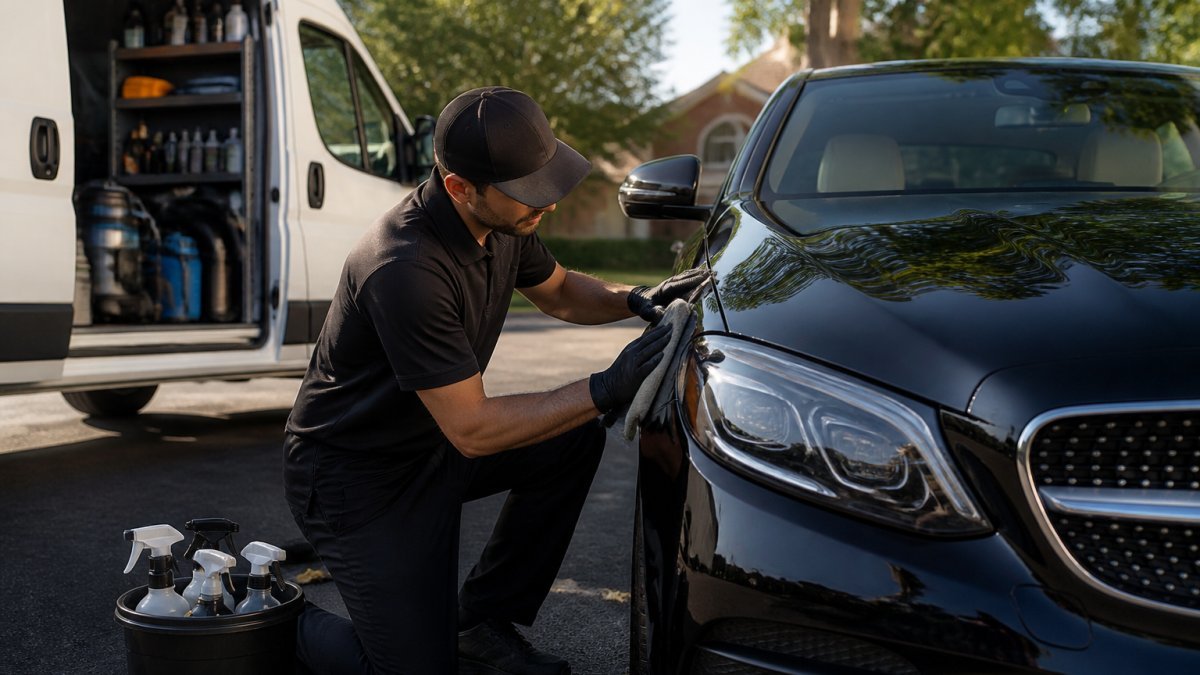
A mobile detailing service for luxury vehicles brings the entire detail operation to your driveway, dock, or office parking deck, which removes the two biggest risks of a shop visit: the drive there and the hours spent waiting.
Consider what a shop visit actually costs. You drive across town on a dirty car, hand over the keys, arrange a ride, and lose half a day.
Mobile service flips the sequence. The car stays put, the work happens in front of you, and you can inspect the finished result before the detailer packs up.
The catch is that not every mobile setup is built for luxury finishes.
What a Full Luxury Mobile Detail Includes: Interior, Exterior, Wheels and Tires
A full luxury mobile detail covers four zones: interior deep cleaning, exterior hand wash, wheels and tires, and protected finishing.
Interior Detailing and Deep Cleaning for Leather, Alcantara and Trim
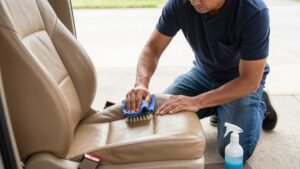
Interior work on a luxury vehicle starts with identification, not cleaning. Leather, Alcantara, open-pore wood, piano-black trim, and matte plastics each react differently to the same towel and the same chemical.
A common mistake is treating every surface with one all-purpose cleaner. On coated leather that strips the factory finish. On Alcantara it mats the fibers permanently. A detailer who knows luxury interiors will match the product to the material and test in a hidden spot first.
Exterior Hand Wash, Wheels and Tires, and Safe Drying
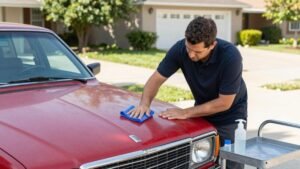
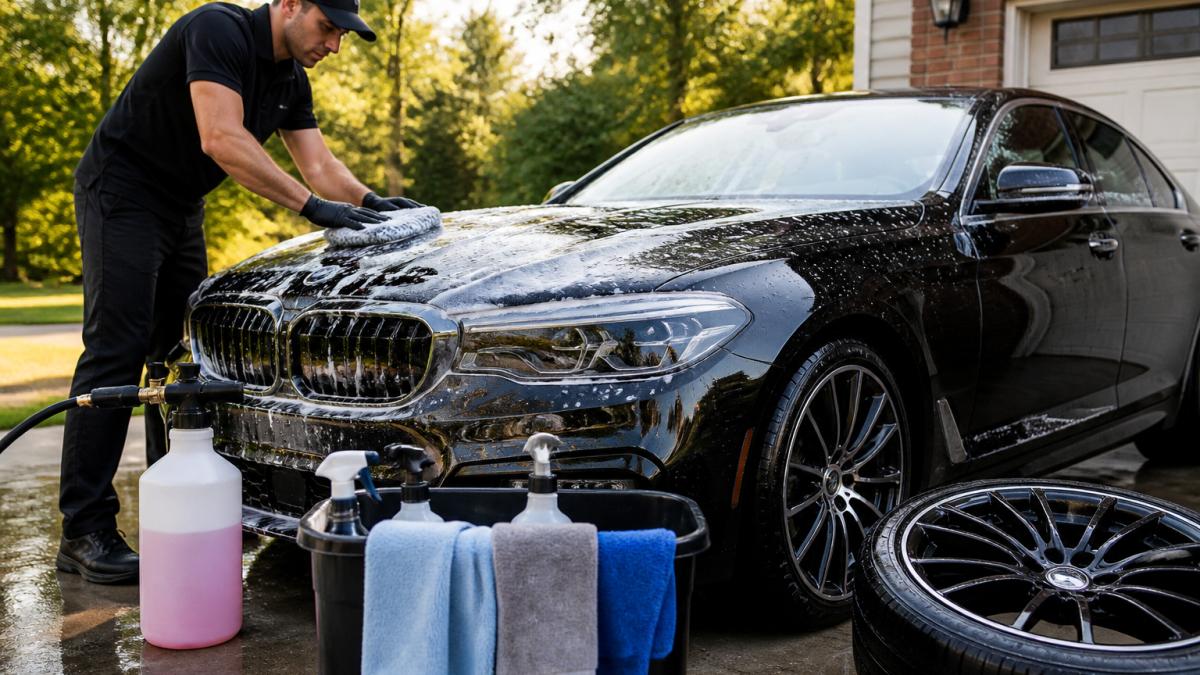
Exterior care means a hand wash with the two-bucket method, dedicated wheel and tire tools kept separate from paint tools, and drying with plush microfiber or forced air rather than a chamois. Contamination is the enemy here: a sponge that touched a wheel should never touch a fender.
Paint Correction for Luxury Cars: What It Fixes and What It Cannot
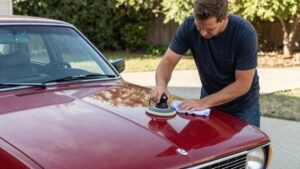
Paint correction for luxury cars removes swirl marks, light scratches, oxidation, and holograms left by poor machine polishing, restoring depth and clarity to the clear coat. What it cannot do is add back material that is gone.
This is where expectations need calibrating before anyone touches a polisher. A one-step correction cleans up gloss and removes light defects. A multi-stage correction removes more, but it also removes more clear coat, which is a finite resource.
Skipping a paint thickness reading before machine polishing is the most expensive shortcut in this trade. Over-polishing a panel can burn through clear coat, and the repair is a respray, not another polish.
Ceramic Coating for Luxury Cars: Protection, Gloss and Warranty Terms
Ceramic coating for luxury cars is a liquid polymer applied to corrected paint that cures into a semi-permanent layer, adding gloss, making washing easier, and shielding the clear coat from UV, bird droppings, and water spots. It is not a force field.
Warranty terms are where coatings differ most. Ask three questions before booking:
- What exactly does the warranty cover, and what voids it?
- Does it require annual inspections or maintenance washes to stay valid?
- Is the warranty tied to the installer or to the vehicle if you sell it?
A certified installer will answer all three without hesitation. At Blue Ridge – Mobile Detailing, we install coatings as a certified installer.
Mobile Detailing Cost: What Drives the Price and How Packages Compare
Mobile detailing cost depends on vehicle size, condition, service level, and whether paint correction or coating is included. There is no honest flat rate, because a well-kept SUV and a swirled-out coupe are not the same job even when they occupy the same footprint. What a serious provider can do is show you the line items that move the number, so you can see where your quote comes from instead of guessing.
Here is how the typical service levels stack up:
| Service Level | What It Covers | Time on Site | Typical Add-Ons Priced Separately |
|---|---|---|---|
| Express | Hand wash, wheels, quick interior wipe-down | Under 2 hours | Engine bay, pet hair removal |
| Full detail | Deep interior, hand wash, wheels, sealant | 3+ hours | Clay bar decontamination, ozone treatment |
| Correction package | Full detail plus one or multi-stage polish | Full day or more | Paint thickness readings, panel prep wipe |
| Coating package | Correction plus ceramic application and cure | Multi-day | Coating maintenance wash, annual inspection |
Four variables drive the final number more than anything else:
- Vehicle size and panel count. A long-wheelbase sedan or a three-row SUV has more square footage of paint, more glass, and more interior surface than a two-door coupe. Expect the same package to price higher on the larger vehicle.
- Condition, not age. A one-year-old car that lives outside and is washed at tunnel car washes can carry more swirl marks than a five-year-old garaged car. Correction time is priced on defect severity, which is why a detailer should inspect under proper lighting before quoting.
- Paint protection stage. A one-step polish, a two-step correction, and a multi-stage correction are three different labor budgets. Coating adds its own material cost and a cure window during which the car cannot get wet.
- Add-ons and access. Pet hair, sand, spilled liquids, third-row seating, and heavy brake dust all add time. So does a tight parking garage with no shade or water access.
Ask whether the quoted price includes paint decontamination (clay bar or chemical iron removal). A coating applied over bonded contaminants will fail early, and some providers price that step separately.
A useful way to compare quotes is to ask each provider for the same three-line breakdown: labor hours estimated, products and materials included, and what is explicitly excluded. Two quotes that look far apart often differ only in whether decontamination and panel prep are bundled or billed as add-ons. Comparing on that breakdown is fairer than comparing headline numbers.
Pricing depends on your vehicle’s size, condition, and the package you choose. We quote each job individually rather than publishing a number that would mislead half our customers. Request a quote and you will get a real figure for your car.
How Often to Detail a Luxury Car: A Maintenance Schedule That Works
How often to detail a luxury car comes down to three variables: how it is stored, how it is driven, and whether it wears a coating. A garaged weekend car and a daily-driven SUV parked outside need very different schedules.
A workable baseline:
- Weekly: A rinseless or two-bucket wash if the car is a daily driver.
- Monthly: Wheels and tires deep-cleaned, interior vacuumed.
- Quarterly: Full detail with sealant refresh or coating maintenance.
- Annually: Paint inspection under proper lighting, plus a decontamination wash.
Coated cars can stretch intervals, but only if the wash routine is right. Bad washing is what puts swirl marks back into a coated finish.
How to Vet a Mobile Detailer Before You Book
Vetting a mobile detailer means verifying four things: insurance, product knowledge, references from owners of similar vehicles, and a clear written scope of work. Any one of those missing is a reason to keep looking. On a luxury vehicle the stakes are higher, because a single bad product choice on Alcantara or a burned edge on piano-black trim is expensive to reverse.
Use this checklist and ask for evidence, not assurances:
- Insurance and business legitimacy. Ask for a certificate of insurance showing general liability coverage, and confirm the business name on the certificate matches the name on the quote. A provider who cannot produce a certificate is transferring risk to your vehicle.
- Training and product compatibility. Ask which product lines they use on coated leather, Alcantara, matte paint, and piano-black trim, and whether they have manufacturer training or certification for the coating they install. Specific product names and a test-spot habit are better signals than the word “premium.”
- Equipment for luxury finishes. A luxury-capable mobile unit carries inspection lighting, a paint thickness gauge for correction work, dedicated wheel and paint tools kept separate, and either an onboard water tank or a verified water source. Ask what they bring and whether they read paint thickness before polishing.
- Damage-prevention practices. Ask how they handle trim removal, badge edges, and panel gaps, and whether they use tape on sensitive edges before machine polishing. Ask what happens if something goes wrong, in writing.
- References from comparable vehicles. Request references from owners of luxury or classic vehicles, not just daily drivers. A detailer who regularly works on delicate finishes can describe the specific risks they manage.
The single best vetting question is about process, not price: ask them to walk you through their wash sequence step by step, then ask what they would do differently on a matte-paint car versus a coated gloss car. Anyone who does this daily can describe both without thinking, and the answer tells you more than any review score.
A professional answers these in plain language. Vague answers about “premium products” without specifics are a warning sign. So is a provider who will not put the scope in writing, or who brushes off the paint thickness question on a correction job.
Water, Power and Location: How On-Site Detailing Actually Works
On-site detailing works because a properly equipped mobile unit carries its own water and power, so your driveway needs nothing more than space to park. That is the honest answer to the skepticism most people have about mobile service.
Here is what a real setup requires:
- Water: An onboard tank, or a verified customer supply, plus a containment plan so runoff does not stain your driveway.
- Power: A generator or a safe connection to an outdoor outlet, sized for polishers and extractors.
- Space: Roughly two car lengths of clearance, shade if available, and room to work around all four sides.
- Lighting: Inspection lighting is essential for correction work. You cannot fix defects you cannot see.
If a provider shows up without lighting for a correction job, the results will be inconsistent. That is not a knock on mobile service in general. It is a knock on that provider.
Luxury paint does not forgive shortcuts, and the difference between a detail that protects your investment and one that quietly damages it comes down to process, products, and who is holding the polisher. Blue Ridge – Mobile Detailing brings fully mobile interior and exterior detailing, multi-stage paint correction, and certified ceramic coating installation to your home, office, or fleet location, with no drop-off and no shop schedule.
Frequently Asked Questions
Is mobile detailing safe for luxury vehicles?
Yes, when the detailer uses the right process. A luxury mobile detailing service should hand wash with pH-neutral soap, use two-bucket methods and clean microfiber towels, and keep wash and rinse water off the paint between passes. Ask what products they use on leather, Alcantara and gloss trim, and confirm they carry their own water and power so your driveway stays clean. Paint-safe technique matters more than the location.
How much does auto detailing cost for a luxury vehicle?
Mobile detailing cost depends on vehicle size, condition, and the service level you choose. A maintenance wash sits at the low end, a full interior and exterior detail costs more, and multi-stage paint correction or ceramic coating adds the most because of labor hours. Blue Ridge – Mobile Detailing does not publish flat rates, so request a quote for an accurate number.
How often should a luxury car be detailed?
Most luxury vehicles benefit from a full detail every three to four months, with a maintenance hand wash every two to four weeks in between. Cars parked outside, driven on gravel, or exposed to road salt need more frequent attention. If your car has a ceramic coating, an annual inspection keeps the warranty valid. Daily drivers and weekend classics follow different schedules, so match the cadence to how the car is stored and used.
How do I choose a detailer for a luxury car?
Ask three things: what training or certification they hold, whether they carry liability coverage, and whether they can show before-and-after photos of paint correction on a similar finish. A certified ceramic coating installer should explain prep steps, cure time and warranty terms. Request references from owners of high-end vehicles, and confirm the detailer brings filtered water, a power source, and dedicated microfiber supplies to your location.