Table of Contents
- Does Mobile Detailing Damage Car Paint? The Short Answer
- What Mobile Car Detailing Actually Involves
- How to Prevent Swirl Marks When Washing a Car
- Safe Car Washing Techniques Detailers Use on Site
- Common Causes of Paint Damage During a Mobile Appointment
- Can Car Detailers Fix Paint Scratches?
- Questions to Ask a Mobile Detailer Before Booking
- Paint-Safe Aftercare and What to Do If You Notice Damage
- Frequently Asked Questions
Last Updated: October 9, 2026
Does Mobile Detailing Damage Car Paint? The Short Answer
No, mobile detailing does not damage car paint when the detailer uses proper technique. The damage people blame on mobile detailing usually comes from dirty wash tools, harsh chemicals, or working in direct sun.
The real question isn’t whether mobile detailing damages paint. It’s whether the person holding the wash mitt knows what they’re doing.
What Mobile Car Detailing Actually Involves
Mobile car detailing is a full professional detail performed at your home or workplace using a self-contained setup: exterior washing, decontamination, interior cleaning, and often paint correction or protection.
A typical appointment covers:
- A pre-wash rinse to lift loose dirt
- A contact wash using clean mitts and soap
- Wheel, tire, and trim cleaning with separate tools
The detailer carries water, power, and all cleaning products on board.
How a Mobile Appointment Differs From a Shop Visit
A shop gives the detailer a controlled bay with shade, drainage, and stable lighting. A mobile setup trades that control for convenience, so the detailer must manage sun, wind, water access, and the work surface.
That difference matters: hot paint reacts differently to products, wind blows dust onto wet panels, and gravel driveways kick up grit. Good mobile detailers plan around all of it.
How to Prevent Swirl Marks When Washing a Car
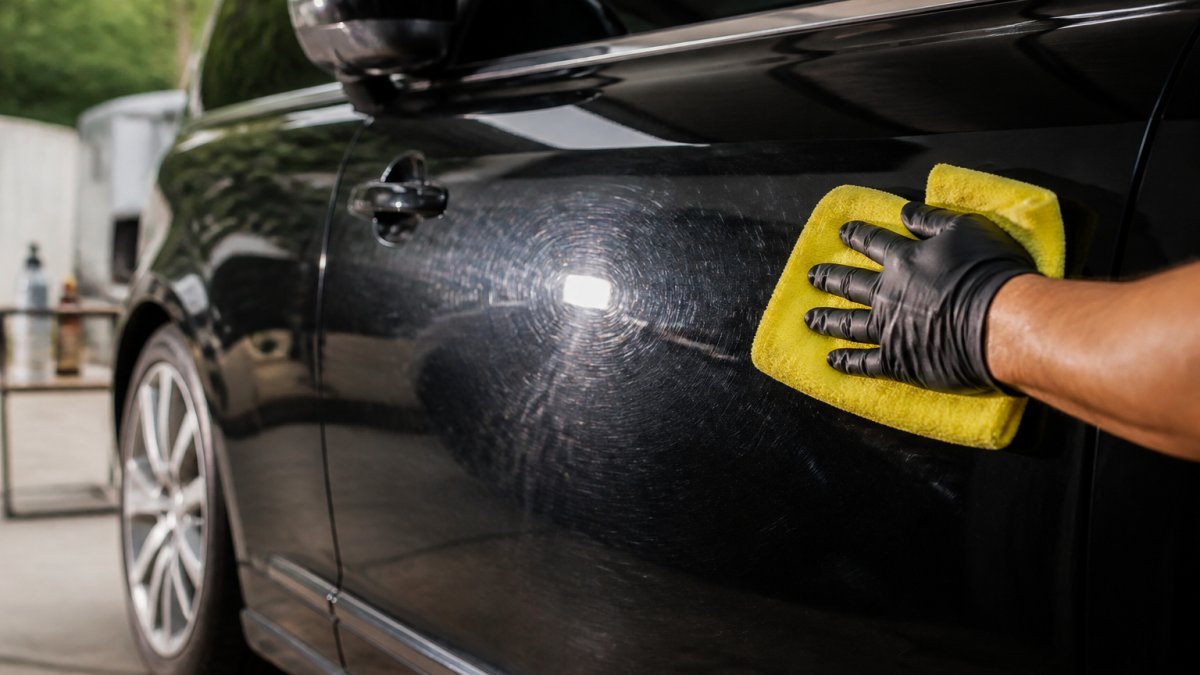
Swirl marks come from dragging abrasive particles across the paint, not from the water itself. The fix: touch the paint as little as possible, and never with anything dirty.
Here’s how to prevent swirl marks when washing a car:
- Rinse the panel before you touch it
- Use two buckets, one for soap and one for rinse water
- Add a grit guard to each bucket to trap debris at the bottom
The Two-Bucket Method and Grit Guards
The two-bucket method keeps dirty water away from your paint: load soap from bucket one, wash a panel, then rinse the mitt in bucket two before reloading. The grit guard sits at the bottom of the rinse bucket and stops grit from swirling back into the mitt.
Skipping this step is the single most common cause of fine scratches on a previously clean finish.
Safe Car Washing Techniques Detailers Use on Site
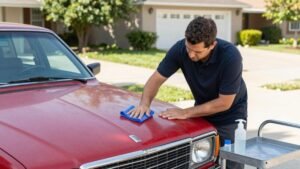
Safe car washing techniques start with a foam pre-soak, then a gentle hand wash with clean media, then a careful dry, removing dirt before any cloth touches the surface.
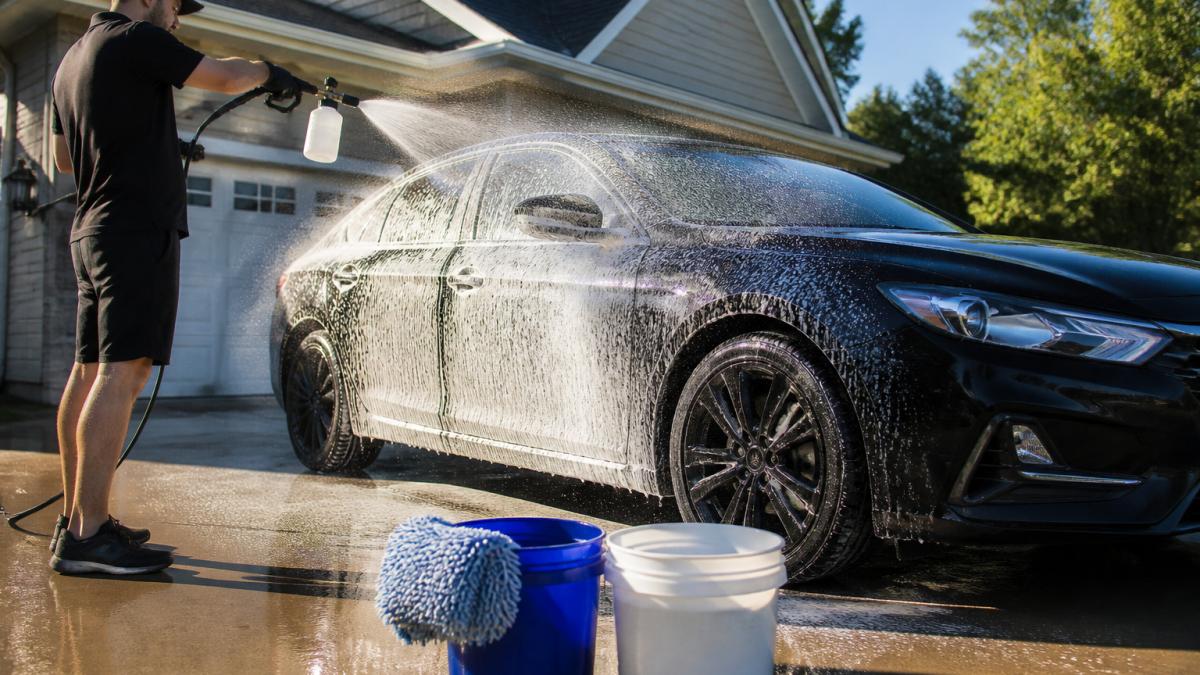
On site, a detailer also manages the environment:
- Park in shade when possible
- Work one section at a time to limit drying
- Keep water and product off hot panels
A clay bar or iron remover may follow if the paint feels rough, pulling out embedded contaminants washing alone won’t remove.
Common Causes of Paint Damage During a Mobile Appointment
Real paint damage during a mobile appointment almost always traces back to avoidable causes, conditions and shortcuts, not detailing itself. What separates a safe appointment from a risky one is whether the detailer controls the three things that scratch, etch, or thin clear coat: abrasive particles, chemical exposure time, and heat.
Abrasive Particles Trapped in Wash Media
Clear coat is roughly 1.5 to 2.5 mils thick on most modern vehicles, and a single grain of sand dragged across it under hand pressure can cut a visible scratch.
Where this happens on a mobile job:
- A mitt that was dropped on the driveway and reused without rinsing
- A rinse bucket without a grit guard, so grit recirculates into the mitt
- A drying towel that touched the ground or a wheel before the paint
A detailer who uses one bucket, one mitt, and one towel for the whole car is running the most reliable way to install swirl marks on an otherwise clean finish.
Inadequate Rinsing and Pre-Soak
Skipping the pre-rinse means the first contact wash loosens and removes dirt at the same time, so the mitt picks up grit and drags it.
On a mobile setup this step is often cut short because water capacity is limited; a detailer working from a tank may ration rinse water, increasing grit concentration on the mitt.
Contaminated Towels and Cross-Contamination
Microfiber holds particles, so a towel that dried a wheel, door jamb, or rocker panel should never touch the hood, roof, or trunk lid, same for wash mitts.
Towels also need washing after every job with dedicated microfiber detergent, not fabric softener, which clogs fibers and reduces their ability to lift particles.
Polishing Too Aggressively or Too Often
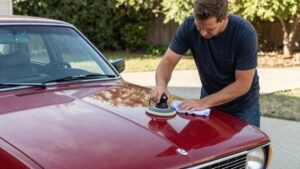
Polishing removes a thin layer of clear coat to level the surface, that’s the point, but the risk is cumulative.
The safe approach: measure clear coat thickness with a paint depth gauge, start with the least aggressive combination that removes the defect, and stop when it’s gone rather than chasing a perfect finish.
Never let anyone polish your car without first confirming they’ll measure the clear coat. Repeated polishing on a thin finish can burn through to the paint, which means an expensive respray.
Heat, Sun, and Fast-Drying Product
Direct sun raises panel temperature, and hot paint changes how products behave: soap dries before it can be rinsed and leaves etching mineral deposits, polishes flash too quickly and leave haze, and wax and sealants cure unevenly. With no bay, the detailer must work in shade or in small sections, keeping the surface wet.
Acidic Contaminants Left Too Long
Bird droppings, tree sap, bug splatter, and industrial fallout are acidic or reactive and etch into the clear coat if left on the surface. A detailer who washes around a dropping instead of softening and lifting it leaves the etch to continue after the appointment ends.
Wind and Work Surface
A windy day blows dust onto wet panels, and a gravel or dirt driveway kicks up grit every time the detailer moves a hose, bucket, or foot. Concrete and asphalt are lower-risk; on gravel, a detailer should lay down a mat or work from a fixed position and keep media off the ground.
Weather, Shade, Water Access, and Work Surface
Weather decides how well a mobile detail turns out: direct sun heats the paint and dries product too fast, wind carries grit, and cold slows how products behave. Shade, a garage, carport, or tree cover, changes the whole job. Water access matters too: a detailer needs a clean supply and a way to manage runoff.
Can Car Detailers Fix Paint Scratches?
Many scratches can be fixed, but not all. If the scratch sits in the clear coat, a detailer can usually remove it; if it reaches the paint or primer, it needs a different fix.
Here’s how to tell the difference:
- Clear-coat scratches: Light, surface-level marks. Often removable with polishing.
- Paint chips: Small missing spots where paint has flaked off. These need touch-up, not polishing.
- Deep scratches: You can feel them with a fingernail. These usually need paint repair.
Polishing removes a thin layer of clear coat to level the surface.
If a scratch catches your fingernail, polishing won’t fix it. That’s a repair job, not a detailing job.
Questions to Ask a Mobile Detailer Before Booking
Most articles tell you to ask questions but not what a good answer sounds like. Vetting a mobile detailer isn’t about collecting reassurances, it’s confirming the person arriving at your home has a process that controls the risks a mobile setting creates: abrasive media, heat, water limits, and uncontrolled surfaces.
Use the questions below as a checklist: each “good answer” tells you what to listen for, and each “warning sign” tells you what should make you pause.
Process and Media
“Walk me through your wash process from arrival to dry.”
- Good answer: A pre-rinse or foam pre-soak, a two-bucket or multi-mitt contact wash, a separate wheel and tire process, and a dedicated drying towel or forced-air dry.
- Warning sign: “I just wash it like normal.” No mention of pre-rinse, buckets, or separate wheel tools.
“How do you keep your wash media clean between panels?”
- Good answer: Grit guards, multiple mitts, or a rinse bucket, plus a stated rule that anything dropped on the ground is retired for the job.
- Warning sign: One bucket, one mitt, no mention of grit guards.
“Do you use separate towels for paint, glass, and wheels?”
- Good answer: Yes, and they can describe how they are laundered (microfiber detergent, no fabric softener, no dryer sheets).
- Warning sign: “A towel is a towel.”
Paint Correction and Clear Coat
“Do you measure clear coat before polishing?”
- Good answer: Yes, with a paint depth gauge, and they can explain why (to avoid removing too much material).
- Warning sign: “I’ve been doing this for years, I can tell by feel.” Feel does not measure thickness.
“What is your least-aggressive-first approach?”
- Good answer: They start with a light polish and pad, test a section, and step up only if the defect remains.
- Warning sign: They name a specific aggressive compound and pad as their default for every car.
“How do you decide between polishing and paint repair?”
- Good answer: They distinguish clear-coat scratches (polishable) from scratches that catch a fingernail or expose primer (repair).
- Warning sign: They claim they can “fix any scratch.”
Environment and Water
“How will you handle shade and surface at my address?”
- Good answer: They ask about garage access, tree cover, driveway material, and time of day, and they adjust the plan accordingly.
- Warning sign: They don’t ask, or they say it doesn’t matter.
“What is your water source and how do you manage runoff?”
- Good answer: They carry their own water or confirm a spigot, and they have a plan for runoff that does not involve letting soapy water pool on your lawn or driveway.
- Warning sign: No clear answer, or they plan to use your hose without asking.
Insurance, Certification, and Recourse
“Are you insured, and can you provide a certificate?”
- Good answer: Yes, and they can send a certificate of insurance on request.
- Warning sign: “I’ve never had a problem.” That is not insurance.
“Do you carry a certification for the coatings you apply?”
- Good answer: Yes, for the specific coating brand they use. Manufacturer certifications usually require training and can affect warranty eligibility.
- Warning sign: They claim to be “certified” without naming the brand or the coating line.
“What is your policy if I notice an issue after the appointment?”
- Good answer: A clear window (for example, 24 to 48 hours) to report concerns, a request for photos in daylight, and a stated process for inspection.
- Warning sign: No policy, or a policy that puts all responsibility on the customer.
Evidence of Work
“Can you show before-and-after photos of paint correction on the same panel under the same light?”
- Good answer: Close-up photos of the same panel, same angle, same lighting, showing swirl marks before and the corrected finish after.
- Warning sign: Only wide shots of a shiny car. Gloss hides defects in photos.
Ask for close-up photos of swirl marks before and after correction, not just wide shots of a shiny car. Gloss hides defects in photos. A true before-and-after shows the same panel under the same light.
A confident detailer will answer all of these without hesitation. Vague answers, or pressure to skip the questions, tell you plenty, if they can’t describe their process in specifics, it probably isn’t consistent enough to protect your paint.
Paint-Safe Aftercare and What to Do If You Notice Damage
Aftercare keeps your finish protected between appointments. A few habits go a long way:
- Wash every two to four weeks with a pH-neutral soap
- Use clean microfiber towels and a separate drying towel
- Reapply wax or sealant on schedule, or maintain a ceramic coating
A paint sealant or ceramic coating adds a protective layer over the clear coat that takes the abuse so your paint doesn’t, and makes future washes easier and safer.
If you notice a new scratch, swirl, or spot after an appointment, say so right away.
Protecting a finish over the long run takes consistent, paint-safe care, and sometimes a professional hand.
Frequently Asked Questions
Can mobile detailing scratch or damage car paint?
Mobile detailing itself does not damage paint when the detailer follows proper technique. Damage happens when contaminated wash mitts, dirty drying towels, or abrasive compounds are used incorrectly. A professional mobile detailer brings clean microfiber towels, fresh wash water, and surface preparation products to each appointment. The risk comes from poor technique, not from the fact that the work happens in your driveway instead of a shop bay.
What causes swirl marks during car detailing?
Swirl marks come from fine scratches in the clear coat, usually caused by dragging dirt across the surface during washing or drying. Using a single bucket, a dirty wash mitt, or an old terry cloth towel pushes grit into the paint. Safe car washing techniques, including the two-bucket method, grit guards, and clean microfiber towels, prevent most swirl marks. Machine polishing with an abrasive compound removes existing ones.
Can car detailers fix paint scratches?
Detailers can remove scratches that sit in the clear coat using paint correction and polishing. If you can feel the scratch with your fingernail, it has likely reached the base coat or primer, and no amount of polishing will fix it. Those deeper scratches need a respray or touch-up paint. A detailer can assess your paint condition and tell you honestly which scratches are correctable and which are not.
What should I ask a mobile detailer before booking?
Ask about their wash process, what cleaning products they use, and whether they carry their own water and power. Confirm they use clean microfiber towels and separate wash mitts for different areas of the vehicle. Ask if they are insured and whether they have experience with your paint type, especially if you have a ceramic coating or a luxury finish. A detailer who answers these questions clearly is likely using paint-safe technique.
Keeping a finish flawless takes the right tools, the right technique, and a detailer who respects your paint. Blue Ridge – Mobile Detailing brings certified ceramic coating installation, multi-stage paint correction, and paint-safe wash methods straight to your driveway. We handle everything from daily drivers to luxury, classic, and fleet vehicles, with fully mobile service and no drop-off required. Get started with Blue Ridge – Mobile Detailing and protect your paint without leaving home.